
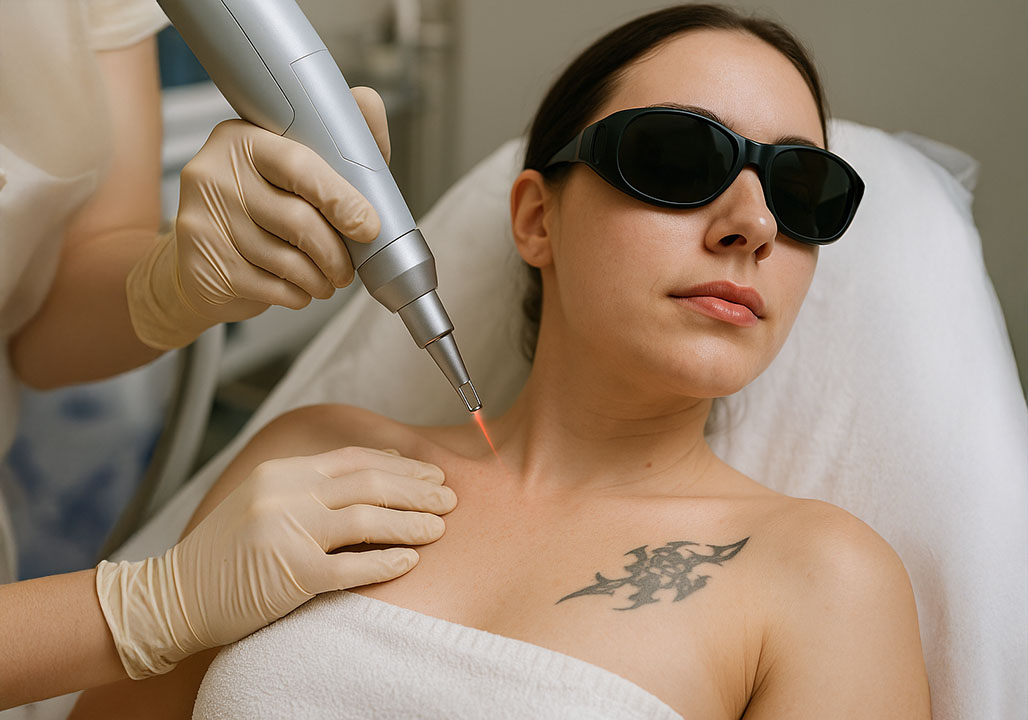
Tattoos are designed to be permanent. The ink is deposited deep within the dermis by thousands of needle punctures, placing pigment particles at a depth that the immune system cannot easily reach or eliminate.
This is precisely why tattoo removal was once considered impossible and why, for many years, the only options were painful, scarring, and unreliable.
Today, Q-Switched laser technology has changed the conversation entirely, offering a medically sound method for safely breaking down tattoo ink with each session.
The Physics of Breaking Down Ink Particles
Q-Switched lasers deliver extremely short bursts of high-intensity light, measured in nanoseconds, directly into the tattooed skin. The speed and intensity of these pulses create a photoacoustic shockwave within the ink particles, shattering them into fragments small enough for the body’s immune system to recognise and process.
This process is called photothermolysis, and the precision of Q-Switched technology means it targets the ink while leaving the surrounding tissue largely undisturbed.
The wavelength of light used determines which ink colours are effectively targeted. Q-Switched Nd: YAG lasers operating at 1064 nanometres are particularly effective on dark pigments such as black and dark blue.
A 532 nanometre setting targets red and orange tones. Green and light blue inks are notoriously difficult to remove because they do not absorb these common wavelengths efficiently, sometimes requiring different laser platforms or additional sessions.
Your Lymphatic System Does the Heavy Lifting
Once the laser shatters the ink particles, the work does not stop there. The fragmented pigment is recognised by the body as a foreign substance and gradually cleared through the lymphatic system. Macrophages, the immune cells responsible for waste removal, engulf the smaller ink particles and transport them away from the skin over the weeks following each treatment session.
This is why tattoo removal is a gradual process measured in months rather than weeks. The body needs time between sessions to clear the debris from each treatment before the next round of laser energy is applied. Rushing the process by scheduling sessions too closely together does not accelerate the results; it simply risks overworking the skin without giving the immune system adequate time to do its part.
Factors That Determine How Many Sessions You Will Need
Tattoo removal is not one-size-fits-all. Several variables influence the number of sessions required and the likelihood of complete clearance. Older tattoos tend to respond more readily than newer ones because the ink has already partially faded through natural degradation over time. Professional tattoos with dense, deep-set ink require more sessions than amateur tattoos, which are typically applied more superficially and inconsistently.
The location of the tattoo on the body matters as well. Areas with stronger circulation and more active lymphatic drainage, such as the neck and upper limbs, clear ink more efficiently than extremities like the feet and ankles, where circulation is less robust.
Safety, Skin Care, and Realistic Expectations
When performed by a trained clinician using appropriately calibrated equipment, laser tattoo removal is a safe procedure. Temporary side effects include redness, swelling, blistering, and scabbing, all of which are part of the normal healing response and should not be picked or disturbed. The skin requires thorough sun protection throughout the removal course to prevent post-inflammatory hyperpigmentation.
Complete removal is achievable for many tattoos, particularly those with black ink on lighter skin tones. For multicoloured or very densely pigmented tattoos, significant fading rather than complete erasure may be the most realistic outcome.
At Laser Medspa, we assess your tattoo in detail before the first session, giving you an honest, personalised roadmap so you always know what to expect and can move forward with confidence.